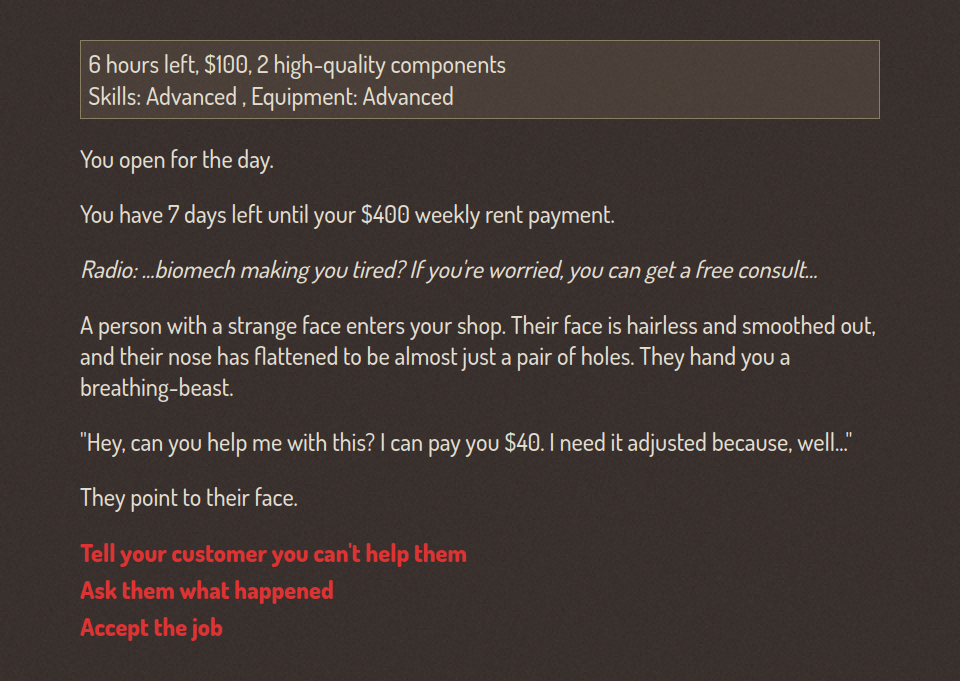
I've made a text-only game in Ink, a programming language specialized for narrative games. In the prototype, customers come in, you diagnose and fix their biomechanoids, and you get paid for it. You need to pay rent and can upgrade your shop's equipment. At first, it's just basic customers, but it turns into more complex stories where you can make Decisions with Consequences. The actual gameplay of repairing is abstracted into a percentage roll.
The game is set in an alternate-history 1993, where instead of microcomputers, we got body horror biomechanoids as the ubiquitous cool new technology. The alternate history goes further than that, though. Ubiquitous Japanese culture is a classic cyberpunk trope, but think that's pretty worn out at this point. But I did want my giant neon signs, so in this version of history, the European colonization of the Americas went rather differently. There's a culturally influential and much more Aztec Mexico immediately to the south of the California bay area where they game is set.

Nahuatl Neon!
So what did I learn from this prototype?
A classic beginner mistake for games is to bore the player with a huge amount of exposition - world building or characters they don't yet care about - before actually letting them play the game. I wanted to avoid that, but I went a bit too far in the other direction and left some of my testers rather confused. So there needs to be brief, punchy "establishing shot" where you can pick up on what's different about this world, and then you get down to your repair shop business, and additional information about the world and what you're doing here gets delivered over time.
I need to integrate story decisions into the gameplay and make them visible: do a repair quickly or well, increase the gain on a device or not, euthanize a suffering biomechanoid, steal some unneeded expensive parts? If the player doesn't know they can make these choices, they might as well not exist. It will be tricky to move from a purely goal-oriented gameplay of "fix the biomech" to one where you can make choices.
There's some interesting threads to pull on in terms of body horror, medical ethics and trauma, wanted and unwanted bodily changes, autonomy, individualism, power - biopunk is twinned with cyberpunk, but it's fleshier, and recognizes the influence and importance of our complex, fallible, beautiful bodies instead of trying to abstract it away. The ideal story beat for this game is one that's based on biomechanoids, and can't just be transplanted into a cyberpunk or real-world setting. What's more, the stories should have interesting decisions for the player to take, and be driven by the characters you encounter.
I actually programmed a little tool for coming up with story ideas. It's like the reverse of an AI. Instead of me giving it prompts to emit story ideas, it prompts me to come up with them. It randomly combines a body horror topic, a biopunk/world topic, and two virtues you need to choose between. For example, "face blindness, womblike living conditions, truth vs kindness" inspired the event in the screenshot at the top. It's not a silver bullet, but I've found it useful. (And to be clear, there's zero LLMs/generative AI involved in making this game.)
So what's next? I'm very pleased with where this has ended up. It's basically a perfectly cromulent little narrative game in its own right. Now it's time to go back to designing and prototyping the game mechanics: the repairing of biomechanoids, the running of your shop, and so on. I'll keep you posted.
(The narrative compels you to subscribe to my mailing list.)